
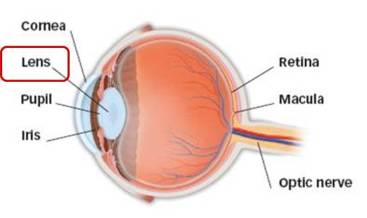
A cataract is a cloudiness of the natural lens that sits inside your eye. Over time, your lens transitions from clear (which is easy to see through), to cloudy (causing blurry vision, glare, and halo around lights). Once a cataract interferes with your vision, it may be time to consider cataract surgery, a procedure that removes your cloudy natural lens and replaces it with a clear lens implant.


The doctors at Eye Physicians of Washington are dedicated to improving your sight. We offer several ways to give you the best vision possible for your particular needs.
Monofocal lens implant. This lens implant corrects your vision at one distance from you (either near, intermediate, or distance). You will require glasses to see more clearly at the other distances.
Toric lens implant. For patients with astigmatism, this implant may offer clearer vision with less reliance on glasses. Having an eye with astigmatism means that the shape of the eye influences the final clarity of your vision. If your eye is perfectly round (like a basketball), the light passing through your eye is focused onto a point. If your eye is astigmatic (or stretched in one direction, like a football), the light passing through your eye is spread out, causing blur. Glasses can be used to compensate for this blur if you do not correct for astigmatism. Or, a toric lens can be implanted. A toric lens aims to reduce your dependence on glasses.
Multifocal lens implant. A multifocal lens aims to correct just that: your vision at multiple focal points (near, intermediate, and distance) all in a single lens implant. The goal of using this lens is to reduce your reliance on glasses, however, you may still require glasses in some situations. Not all people are good candidates for a multifocal lens implant. Ask your eye surgeon if you have any eye health issues that would limit you from using this lens implant.
Light adjustable lens implant. This lens gives a person the most customizable vision. It allows you to test drive your vision after surgery, and then be able to edit your prescription after surgery in the office with a painless, 90-second light treatment. You may edit the prescription several times before you lock-in the treatment and finalize your vision. This lens is suited for someone who wants maximum control of their vision after surgery. It also works well for someone who has had previous refractive eye surgery (like LASIK or PRK), where the eye is no longer “standard” to fit our “standard” measurement calculations.
Femtosecond laser. With this premium service, a real-time, high-resolution image is taken of your eye just before cataract surgery. Using the precise measurements taken, a laser treatment is planned, customized to your anatomy. This laser may take the place of a traditional blade or other surgical instruments used during cataract surgery, and/or it may be used to correct astigmatism. This technology complements your choice of intraocular lens implant and may reduce your reliance on glasses.
Your surgeon at Eye Physicians of Washington can discuss the benefits of this technology during your consultation.
Read more about cataracts from the American Academy of Ophthalmology.
 Eye Physicians of Washington